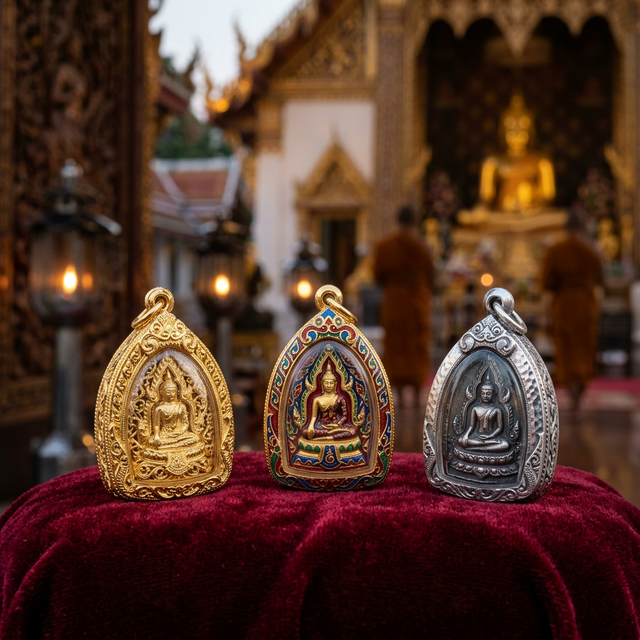
The Beautiful Armor of Faith: Amulet Casing
Once a precious amulet is acquired, the next vital ritual is creating a suitable frame. An amulet casing does more than shield the item from dust and moisture; it is a specialized Thai metalwork art form that instantly elevates the spiritual aura and visual prestige of the artifact.
Common Material Classifications
- Stainless Steel: The practical baseline. Durable and affordable, it is perfect for everyday wear and beginners.
- 925 Sterling Silver: Offers excellent malleability. Through oxidation (sulfuration) techniques, it can achieve an 'antique' look. Hand-carved silver cases provide great value and heritage feeling.
- Custom Gold Casing: The choice of serious collectors. Usually containing 70%-90% gold, these are hand-forged. Intricate Thai 'Lai Thai' floral patterns add immense value and royalty to the amulet.
- Sukhothai Enamel: A technique involving fired colorful glazes on silver or gold. It provides an exotic, vibrant aesthetic and is considered a high art form.
Craftsmanship: Handmade vs. Machine-made
Machine-made cases are precise but soulless. A high-end handmade case is designed specifically for the unique contours of a single amulet. Every engraved line carries the artisan's signature. Furthermore, the 'Waterproof Sealing' technique requires mastery to ensure a perfect vacuum, protecting antique amulets from oxidation.
Aesthetic Advice
- Balance: If the amulet is intricately detailed (like a Phra Kring), a simple, clean gold line is best. If the amulet has a minimalistic design, a lavish enamel frame can add much-needed 'energy.'
- Ergonomics: Ensure the bail is strong and the center of gravity is accurate for long-term comfort.
Conclusion
An amulet case is the extension of one's devotion. It demonstrates that reverence can be reflected in the pursuit of detail. A fine casing honors both the artisan’s spirit and the sanctity of the Buddha image.